
Article Plan: Mary Did You Know Lead Sheet PDF
This article details accessing and utilizing “Mary, Did You Know?” lead sheets in PDF format, covering resources, analysis, and accompaniment techniques for musicians.
“Mary, Did You Know?” transcends typical Christmas carols, resonating deeply with listeners through its poignant lyrics and contemplative melody. Released in 1991, the song quickly became a modern classic, frequently performed during the holiday season and beyond. Its enduring appeal lies in its unique perspective – posing a series of rhetorical questions to Mary, mother of Jesus, prompting reflection on the profound implications of His birth and destiny.
For musicians, the song’s beauty extends to its harmonic structure, making it a popular choice for vocal and instrumental arrangements. Consequently, the demand for accessible “Mary, Did You Know?” lead sheets, particularly in PDF format, remains consistently high. These sheets provide a streamlined version of the song, enabling musicians to quickly learn and perform this beloved piece.
Understanding Lead Sheets in Music
Lead sheets are fundamental tools for musicians, offering a concise musical blueprint. Unlike full scores, they prioritize essential elements – melody, chords, and lyrics – allowing for flexible interpretation and improvisation. They serve as a foundation for accompaniment, arrangement, and performance, catering to diverse musical styles and ensembles.
For songs like “Mary, Did You Know?”, a lead sheet provides a readily accessible format for pianists, guitarists, and vocalists. Musicians can quickly grasp the harmonic progression and melodic contour, facilitating efficient learning and performance. The simplicity of a lead sheet encourages creativity, enabling artists to personalize arrangements while staying true to the song’s core essence. Understanding lead sheets unlocks a world of musical possibilities.
What is a Lead Sheet?
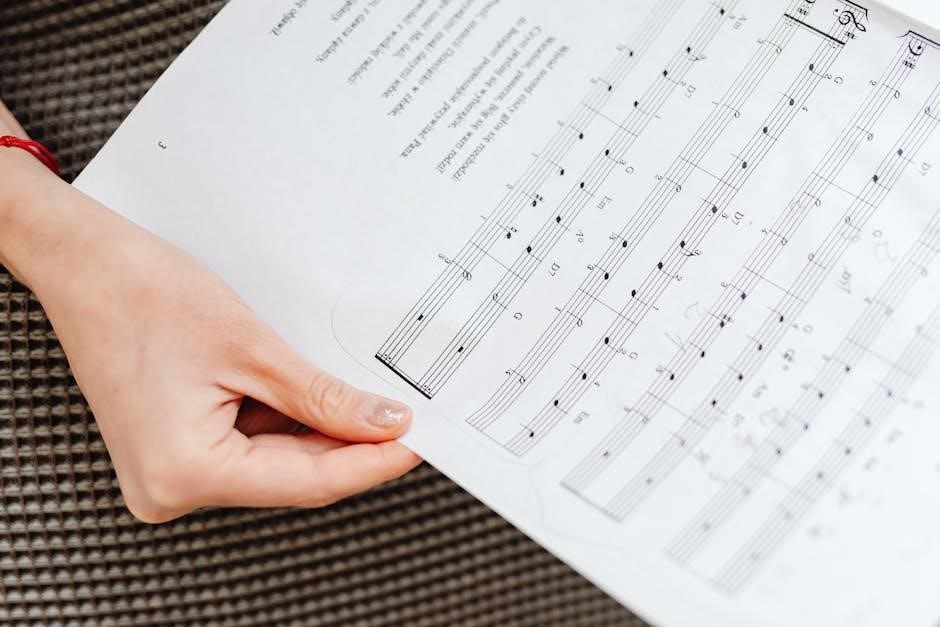
A lead sheet is a simplified musical notation representing a song’s core components. Typically, it displays the melody line written in standard notation, accompanied by chord symbols positioned above the staff. Lyrics are included beneath the melody, aligning with the corresponding musical phrases.
Essentially, it’s a roadmap for musicians, providing enough information to perform and interpret a song without the complexity of a fully orchestrated score. For a song like “Mary, Did You Know?”, a lead sheet would showcase the iconic melody and harmonic structure. It’s a versatile format, ideal for solo performers, bands, and worship teams, fostering creativity and adaptability.
Key Elements of a Lead Sheet: Melody, Chords, and Lyrics
A lead sheet’s foundation rests on three crucial elements: melody, chords, and lyrics. The melody, notated using standard musical notation, guides the tune’s recognizable shape. Chord symbols – like Cmaj7 or Gm7 – indicate the harmonic accompaniment, allowing for improvisation and varied voicings. Lyrics are carefully placed beneath the melody, synchronized to ensure accurate phrasing and emotional delivery.
For “Mary, Did You Know?”, these elements intertwine to create its poignant effect. The melody’s gentle contour, supported by rich chord progressions, and coupled with the song’s reflective lyrics, form a complete musical statement. These components empower musicians to personalize their performance.
Why Musicians Use Lead Sheets
Musicians favor lead sheets for their flexibility and efficiency. Unlike fully-arranged sheet music, lead sheets provide a harmonic and melodic framework, encouraging improvisation and personalized interpretation. They’re ideal for gigging musicians needing a portable, concise resource, and for composers sketching arrangements quickly.
For songs like “Mary, Did You Know?”, a lead sheet allows pianists, guitarists, and vocalists to create unique arrangements. It facilitates accompaniment without rigid structure, enabling dynamic performances tailored to the setting. They’re also invaluable for learning songs by ear, understanding harmonic movement, and developing musicianship skills, fostering creativity.

“Mary, Did You Know?” ⎼ A Brief History of the Song
“Mary, Did You Know?” emerged from a collaborative effort between Buddy Greene and Mark Lowry in 1991. Lowry initially penned the lyrics as a poem contemplating Mary’s perspective during the Nativity, while Greene composed the music. The song wasn’t immediately intended for widespread release; it circulated within their circles before gaining traction.
Its poignant lyrics and emotive melody resonated deeply, leading to its inclusion on various Christmas albums and becoming a modern Christmas standard. The song’s enduring appeal stems from its theological depth and relatable human emotion. Consequently, demand for lead sheets arose, enabling musicians to perform and interpret this beloved carol.
Origins and Authorship (Buddy Greene & Mark Lowry)
Buddy Greene, a seasoned gospel and Christian music artist, brought his musical expertise to the project, crafting the memorable melody of “Mary, Did You Know?”. Mark Lowry, known for his work with the Gaither Vocal Band, contributed the deeply reflective lyrics, initially as a poem exploring Mary’s contemplation of Jesus’s future.
Their collaboration wasn’t a deliberate attempt to write a hit song; rather, it stemmed from a shared desire to express the wonder of the Christmas story. The song’s initial circulation among friends and colleagues quickly expanded, fueled by its emotional impact. This organic growth spurred the need for accessible lead sheets, allowing musicians to share and perform their creation.
The Song’s Theological Themes
“Mary, Did You Know?” profoundly explores the dual nature of Jesus Christ – fully God and fully human. The lyrics pose rhetorical questions, prompting reflection on Mary’s awareness of her son’s divine destiny, contrasting the humble beginnings with his ultimate sacrifice and reign.
The song delves into themes of prophecy, incarnation, and redemption, resonating deeply with Christian audiences. Its power lies in humanizing the biblical narrative, inviting listeners to empathize with Mary’s perspective. Consequently, musicians seeking to faithfully reproduce the song often prioritize accurate lead sheets to convey its emotional and spiritual weight, ensuring the theological message remains central to the performance.
Popularity and Cultural Impact
“Mary, Did You Know?” has become a modern Christmas standard, transcending denominational boundaries and achieving widespread cultural recognition. Its emotional depth and poignant lyrics contribute to its enduring appeal, frequently featured in concerts, church services, and holiday recordings.
The song’s popularity fuels consistent demand for accessible musical arrangements, particularly lead sheets in convenient PDF format. This allows musicians of varying skill levels to perform the piece. The readily available lead sheet versions facilitate diverse interpretations, from simple piano accompaniments to elaborate orchestral arrangements, solidifying its place in contemporary Christmas traditions.
Finding “Mary, Did You Know?” Lead Sheets Online
Locating a “Mary, Did You Know?” lead sheet in PDF format is surprisingly straightforward, thanks to numerous online resources. Several websites specialize in providing free or paid sheet music, including dedicated Christian music archives. Musicnotes.com and Sheet Music Plus are prominent paid providers offering high-quality, officially licensed arrangements.
A simple web search using keywords like “Mary Did You Know lead sheet PDF” yields numerous results. However, verifying the accuracy and legality of free downloads is crucial. Always respect copyright laws and consider supporting creators by purchasing legitimate PDF versions when possible.
Free Lead Sheet Resources (Websites & Archives)
Several websites offer free “Mary, Did You Know?” lead sheets in PDF format, though quality and accuracy can vary. Ultimate-Guitar.com often features user-submitted chord charts, which can serve as a basic lead sheet. Various church music websites and forums also host shared resources, but verifying copyright is essential.
IMSLP (International Music Score Library Project), while primarily focused on classical music, may contain arrangements or transcriptions. Be aware that free resources might lack professional formatting or complete arrangements. Always cross-reference with other sources to ensure accuracy before performance or practice.
Paid Lead Sheet Providers (Musicnotes.com, Sheet Music Plus)
Musicnotes.com and Sheet Music Plus are reliable sources for professionally arranged “Mary, Did You Know?” lead sheets in PDF format. These platforms offer various arrangements, including piano/vocal/guitar versions, instrumental arrangements, and different keys to suit vocal ranges. Purchasing ensures accurate transcriptions and legal compliance with copyright regulations.
Expect to find options ranging from simple lead sheets to more complex arrangements with detailed chord voicings and harmonies. These sites often provide previews, allowing you to assess the arrangement before purchase. While requiring a financial investment, paid resources guarantee quality and support the songwriters.
PDF Format: Advantages and Considerations
PDFs are the dominant format for sharing “Mary, Did You Know?” lead sheets due to their universal compatibility across devices – computers, tablets, and smartphones. They preserve formatting, ensuring the music displays correctly regardless of the user’s operating system. PDFs are easily printable for offline practice and performance.

However, PDFs are generally not editable, meaning you can’t easily transpose or modify the arrangement without separate software. Consider the source’s reputation; poorly scanned or created PDFs may have readability issues; Ensure the PDF is high-resolution for clear notation and a positive musical experience.
Analyzing Common Lead Sheet Arrangements
“Mary, Did You Know?” lead sheet arrangements frequently appear in the key of Eb or G major, accommodating a wide vocal range. Chord progressions often center around a descending bassline, creating a poignant harmonic movement. Expect to encounter common chords like Ebmaj7, Bb7, Cm7, and Abmaj7, providing a rich, emotional texture.
Many arrangements incorporate passing chords and inversions for added color. Analyzing different versions reveals variations in chord voicings and rhythmic interpretations. Understanding these nuances allows musicians to personalize their performance and create unique arrangements of this beloved carol.
Key Signatures and Chord Progressions
“Mary, Did You Know?” lead sheets commonly appear in Eb major (three flats) or G major (one sharp), chosen for vocal accessibility. The song’s harmonic foundation often utilizes a I-vi-IV-V progression, though variations are frequent. Expect chords like Ebmaj7, Gm7, Cm7, and Bb7 in Eb, or Gmaj7, Em7, Cm7, and D7 in G.
A characteristic progression involves descending chromatic movement in the bass, enhancing the song’s emotional depth. Analyzing lead sheets reveals frequent use of seventh chords and inversions, adding harmonic richness. Understanding these patterns allows musicians to easily transpose and adapt the song to different keys.
Variations in Chord Voicings
“Mary, Did You Know?” lead sheets often present chords in root position, but skilled arrangers employ diverse voicings for texture. Common variations include adding extensions like 9ths, 11ths, and 13ths to chords (e.g., Gmaj9 instead of Gmaj7). Inversions – altering the bass note – create smoother transitions and harmonic interest.
Drop 2 and drop 3 voicings are frequently used, particularly in piano arrangements, to spread the sound and create a fuller harmonic palette. Guitarists might utilize shell voicings (root, 3rd, 7th) for a lighter accompaniment. Exploring these voicings enhances the song’s emotional impact and musicality.
Common Transpositions for Different Vocal Ranges
“Mary, Did You Know?” lead sheets are frequently transposed to suit various vocalists. The original key (often G major or A major) may be too high or low for some singers. Common transpositions include moving the song down a whole step to F major or up a half step to A#/Bb major.
Tenors might prefer keys like C or D major, while altos often find E flat or E major comfortable. Bass singers may transpose down to B flat or A flat. When transposing, ensure the lead sheet accurately reflects the new key signature and chord changes, maintaining the song’s harmonic integrity for optimal performance.
Using Lead Sheets for Accompaniment
“Mary, Did You Know?” lead sheets provide a foundation for diverse accompaniment styles. Pianists can utilize the chord symbols to create full arrangements, incorporating arpeggios, inversions, and rhythmic variations; Guitarists commonly employ strumming patterns or fingerpicking techniques based on the chord progressions.
Beyond piano and guitar, lead sheets facilitate accompaniment with other instruments like ukulele, strings, or even wind ensembles. Musicians can adapt the melody and chords to their instrument’s range and timbre. Understanding the song’s structure, as presented in the lead sheet, allows for creative and supportive accompaniment that enhances the vocal performance.
Piano Accompaniment Techniques
Utilizing a “Mary, Did You Know?” lead sheet for piano allows for expressive accompaniment. Begin with basic chord voicings in the left hand, while the right hand can play the melody or embellishments. Explore inversions to create smoother transitions between chords, adding harmonic richness.
Arpeggios and broken chords can provide a flowing texture, contrasting with sustained chords for emphasis. Consider adding a simple bass line mirroring the root notes of the chords. Dynamic variation is crucial; build intensity during emotional peaks and soften during reflective verses. Experiment with rhythmic patterns to complement the song’s lyrical phrasing, enhancing the overall emotional impact.
Guitar Accompaniment Techniques
Employing a “Mary, Did You Know?” lead sheet on guitar opens avenues for beautiful accompaniment. Strumming patterns can range from simple downstrokes to more complex fingerpicking arrangements. Utilize chord voicings that suit your playing style and the song’s mood – open chords offer resonance, while barre chords provide versatility.
Adding passing chords and subtle embellishments enhances harmonic interest. Consider incorporating a walking bass line using the lower strings. Dynamics are key; softer strumming during verses and more forceful strumming during choruses create contrast. Experiment with arpeggiation for a delicate texture, and utilize hammer-ons and pull-offs for melodic flourishes.
Other Instrument Accompaniment (e.g., ukulele, strings)
A “Mary, Did You Know?” lead sheet readily adapts to diverse instrumentation. Ukulele accompaniment benefits from simplified chord voicings and a gentle strumming pattern, creating a warm, intimate feel. String arrangements can range from simple sustained chords to intricate countermelodies.
Cellos and violas provide rich harmonic support, while violins can carry the melody or add soaring descants. Consider layering instruments for a fuller sound. Piano can double the chords or provide rhythmic punctuation. Experiment with dynamics and textures to create a nuanced arrangement. Remember to adjust voicings to suit each instrument’s range and timbre, enhancing the song’s emotional impact.
Lead Sheet Variations and Arrangements
“Mary, Did You Know?” lead sheets appear in numerous arrangements catering to different skill levels. Simplified versions often reduce complex chords to basic triads, ideal for beginners. More advanced arrangements incorporate seventh chords, inversions, and passing chords for harmonic richness.
Vocal lead sheets prioritize melody and lyrics, with minimal accompaniment cues. Instrumental lead sheets may include more detailed harmonic information and suggested voicings. Some arrangements feature intros, interludes, and outros, expanding beyond the core song structure. Exploring these variations allows musicians to personalize their performance and adapt the song to their unique style and ensemble.
Simplified Lead Sheets for Beginners
Beginner lead sheets for “Mary, Did You Know?” prioritize playability, often featuring only the essential melody, lyrics, and basic chord changes. Complex chords like diminished or augmented variations are typically replaced with simpler major or minor equivalents. These arrangements frequently omit intricate rhythmic patterns or embellishments, focusing on a straightforward harmonic foundation.
The goal is to provide a manageable starting point for musicians learning the song. Simplified versions often utilize common chord voicings in first or second inversion, making transitions smoother. These resources are invaluable for those new to lead sheet reading or piano/guitar accompaniment, fostering confidence and musical growth.
More Complex Arrangements for Advanced Musicians
Advanced “Mary, Did You Know?” lead sheets delve into sophisticated harmonic textures and rhythmic nuances. Expect to encounter extended chords – 9ths, 11ths, and 13ths – alongside passing chords and secondary dominants, enriching the harmonic palette. These arrangements often incorporate intricate voicings, demanding a higher level of piano or guitar proficiency.
Furthermore, advanced versions may include detailed rhythmic notation, including syncopation and subtle variations. Instrumental lead sheets might feature countermelodies or harmonic fills. These resources challenge experienced musicians to explore the song’s emotional depth, offering opportunities for creative interpretation and personalized arrangements.

Vocal Lead Sheets vs. Instrumental Lead Sheets
“Mary, Did You Know?” lead sheets present in two primary formats: vocal and instrumental. Vocal lead sheets prioritize the melody line with lyrics and chord symbols above, designed for singers and accompanying musicians. They often include phrasing marks and dynamic indications to guide vocal performance.
Instrumental lead sheets, conversely, focus solely on the melody and chord changes, omitting lyrics. These are tailored for instrumentalists creating arrangements or improvising solos. They may include more detailed harmonic information, such as chord voicings or suggested inversions. Choosing the appropriate format depends on the intended use and the musician’s role within an ensemble.
Copyright and Legal Considerations
“Mary, Did You Know?” lead sheets are generally copyrighted material, protecting the song’s composition. Downloading or distributing copyrighted lead sheets without permission infringes on the rights of the copyright holder – Buddy Greene and Mark Lowry’s publishers. Public domain status doesn’t apply to this contemporary Christian hymn.
Fair use guidelines allow limited use for educational purposes, like analysis or personal study, but performance requires licensing. Churches and organizations performing the song publicly need to obtain the appropriate licenses from performance rights organizations (PROs) like ASCAP or BMI. Ignoring these regulations can lead to legal repercussions and financial penalties.
Public Domain vs. Copyrighted Material
“Mary, Did You Know?” lead sheets are definitively not in the public domain. Unlike traditional hymns centuries old, this song was written in 1995, well within current copyright terms. Public domain works are free to use without permission, but contemporary songs retain copyright protection for the life of the author plus 70 years, or a fixed term for corporate works.
Therefore, any lead sheet found online is likely protected by copyright, requiring permission for distribution or commercial use. Utilizing unauthorized copies constitutes infringement. Understanding this distinction is crucial for musicians and worship leaders seeking legal and ethical access to the song’s arrangement.
Fair Use Guidelines for Lead Sheets
Regarding “Mary, Did You Know?” lead sheets, fair use is a limited exception to copyright. It generally permits using copyrighted material without permission for purposes like criticism, commentary, news reporting, teaching, scholarship, or research. However, simply copying a lead sheet for personal use or performance doesn’t automatically qualify.
Transformative use – altering the lead sheet significantly – strengthens a fair use claim. Small excerpts for educational purposes might be permissible. Commercial use, widespread distribution, or performing the song for profit almost always requires licensing. Always err on the side of caution and seek permission when unsure, respecting copyright law.
Licensing Requirements for Performance
Performing “Mary, Did You Know?” publicly, even with a lead sheet PDF, typically requires licensing from copyright holders. This includes performances in churches, concerts, or any venue where an audience gathers. Organizations like ASCAP, BMI, and SESAC collect performance royalties on behalf of songwriters and publishers.

A license ensures composers receive compensation for their work. Obtaining a license can involve paying a fee based on attendance and the song’s popularity. Failure to comply can result in legal repercussions. Check with the performing rights organizations to determine specific requirements for your situation and ensure legal compliance when using the lead sheet.
Resources for Further Learning
To deepen your musical understanding alongside utilizing “Mary, Did You Know?” lead sheets, explore online music theory tutorials. Websites like Teoria and musictheory.net offer comprehensive lessons on chord progressions and key signatures. Chord charting websites, such as Ultimate-Guitar, provide extensive chord libraries and song arrangements.
For creating your own arrangements, consider music arrangement software like MuseScore or Sibelius. These tools allow you to transcribe, edit, and customize lead sheets. Further research into copyright law regarding musical works is also beneficial. These resources will enhance your ability to interpret and perform the song effectively.
Online Music Theory Tutorials
Enhance your comprehension of the harmonic structure within “Mary, Did You Know?” lead sheets through dedicated online music theory tutorials. Platforms like Khan Academy offer free courses covering fundamental concepts like key signatures, chord construction, and progressions. Teoria.com provides interactive exercises to solidify your understanding of music theory principles.
JustinGuitar.com, while guitar-focused, offers valuable lessons applicable to all musicians. Understanding these concepts will empower you to analyze and adapt lead sheet arrangements, facilitating more informed accompaniment and improvisation. These resources bridge the gap between reading a lead sheet and truly understanding the music.
Chord Charting Websites
Several websites specialize in providing chord charts, assisting musicians in deciphering “Mary, Did You Know?” lead sheets. Ultimate-Guitar.com boasts a vast library of user-submitted chord charts, often including multiple arrangements and variations. Chordify automatically detects chords from audio or YouTube links, offering a quick starting point.
However, always verify accuracy, as user-generated content can contain errors. Websites like Songsterr provide interactive tablature and chord diagrams, useful for guitarists. These resources streamline the process of learning the song’s chord progression, enabling quicker practice and performance preparation. Cross-referencing multiple sources is highly recommended.
Music Arrangement Software
For musicians desiring customized arrangements of “Mary, Did You Know?” from lead sheets, music arrangement software proves invaluable. Programs like MuseScore (free and open-source) and Sibelius (paid) allow importing PDF lead sheets and editing notes, chords, and instrumentation.
GarageBand and Logic Pro X (Apple) offer similar capabilities alongside audio recording and mixing features. These tools facilitate creating personalized backing tracks, vocal harmonies, or instrumental parts. Users can transpose keys, adjust voicings, and experiment with different arrangements. Mastering such software unlocks creative potential, transforming a simple lead sheet into a fully realized musical piece.